
1. Introduction
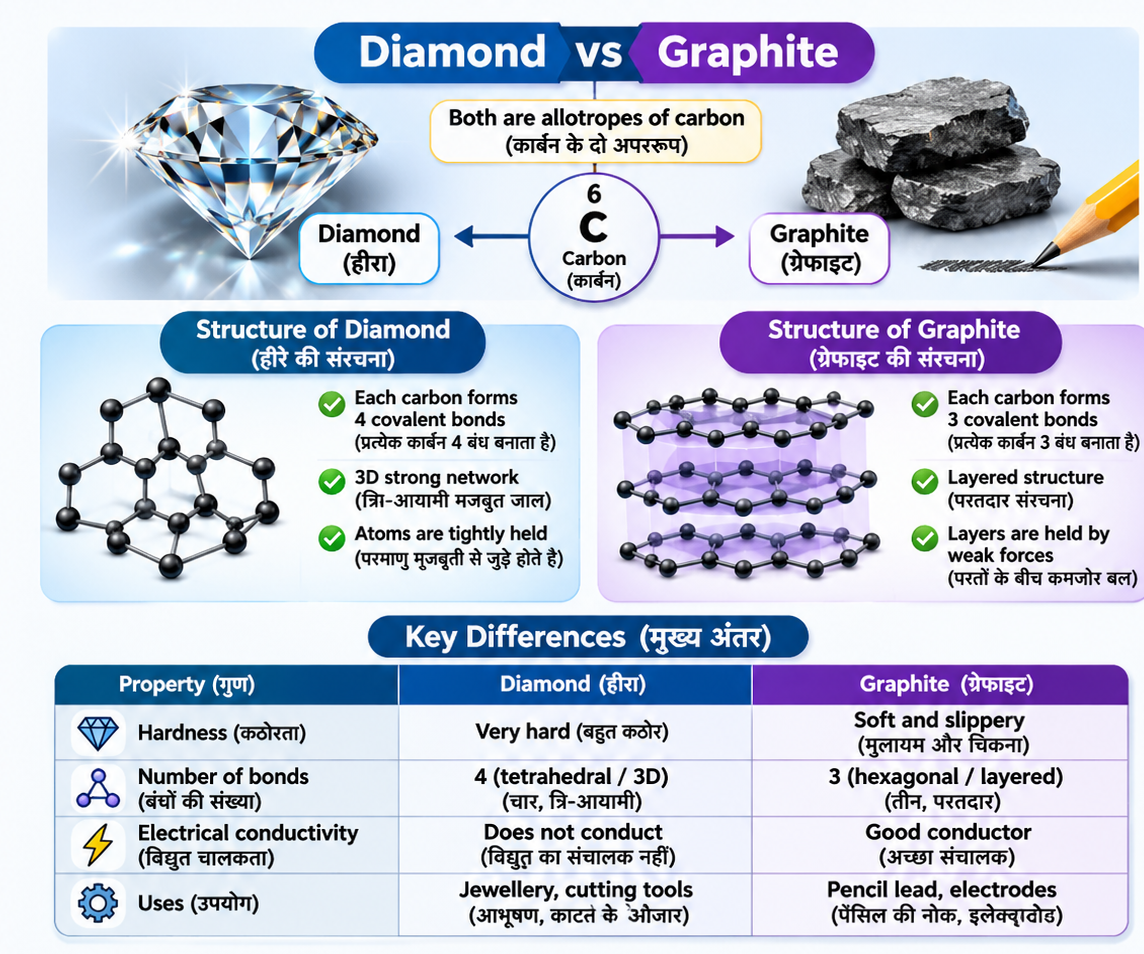
Diamond and graphite are two allotropes of carbon. This means both substances are made only of carbon atoms, but the atoms are arranged and bonded differently. Because of this difference in structure, diamond is extremely hard, while graphite is soft and slippery.
हीरा और ग्रेफाइट कार्बन के दो अपररूप (Allotropes) हैं। दोनों केवल कार्बन परमाणुओं से बने होते हैं, लेकिन इनमें कार्बन परमाणुओं की व्यवस्था और बंधन अलग-अलग होते हैं। इसी संरचनात्मक अंतर के कारण हीरा बहुत कठोर होता है, जबकि ग्रेफाइट मुलायम और चिकना होता है।
2. Why is diamond hard?
Each carbon atom has four electrons in its outermost shell. In diamond, every carbon atom shares these four electrons with four neighbouring carbon atoms. As a result, each carbon atom forms four strong covalent bonds.
These bonds extend throughout a strong three-dimensional network. The atoms are held firmly in place, so it is very difficult to scratch or deform diamond.
कार्बन के बाहरी कक्ष में चार इलेक्ट्रॉन होते हैं। हीरे में प्रत्येक कार्बन परमाणु अपने चार पड़ोसी कार्बन परमाणुओं के साथ इलेक्ट्रॉन साझा करता है। इस प्रकार प्रत्येक कार्बन परमाणु चार मजबूत सहसंयोजक बंध (Covalent Bonds) बनाता है।
ये बंध पूरे पदार्थ में एक मजबूत त्रि-आयामी जाल बनाते हैं। इसलिए परमाणु अपनी जगह पर मजबूती से बंधे रहते हैं और हीरे को खरोंचना या उसका आकार बदलना बहुत कठिन होता है।
3. Why is graphite soft?
In graphite, each carbon atom forms strong covalent bonds with only three neighbouring carbon atoms. These bonds form flat layers of hexagonal arrangements.
The fourth outer electron of each carbon atom is not used to form a fourth bond in the same way. It becomes delocalised within the layer and can move through it. This helps graphite conduct electricity.
The forces between one graphite layer and the next are much weaker than the strong covalent bonds within each layer. The layers can slide over one another easily. That is why graphite is soft and slippery.
ग्रेफाइट में प्रत्येक कार्बन परमाणु केवल तीन पड़ोसी कार्बन परमाणुओं के साथ मजबूत सहसंयोजक बंध बनाता है। इससे षट्कोणीय व्यवस्था वाली सपाट परतें बनती हैं।
प्रत्येक कार्बन का चौथा बाहरी इलेक्ट्रॉन उसी प्रकार चौथा बंध बनाने में उपयोग नहीं होता। वह परत के भीतर विस्थानीकृत (delocalised) हो जाता है और गति कर सकता है। इसी कारण ग्रेफाइट विद्युत का संचालन करता है।
ग्रेफाइट की एक परत और दूसरी परत के बीच आकर्षण बल, एक ही परत के भीतर के सहसंयोजक बंधों की तुलना में कमजोर होते हैं। इसलिए परतें एक-दूसरे पर आसानी से फिसल सकती हैं। इसी कारण ग्रेफाइट मुलायम और चिकना होता है।
4. Diamond vs Graphite
- Diamond: Four covalent bonds per carbon atom; a strong three-dimensional network; extremely hard.
- Graphite: Three covalent bonds per carbon atom; layered structure; layers slide; soft and slippery.
- Electrical conductivity: Graphite conducts electricity because it has mobile delocalised electrons; diamond does not conduct electricity under ordinary conditions.
- हीरा: प्रत्येक कार्बन परमाणु चार सहसंयोजक बंध बनाता है; मजबूत त्रि-आयामी संरचना; बहुत कठोर।
- ग्रेफाइट: प्रत्येक कार्बन परमाणु तीन सहसंयोजक बंध बनाता है; परतदार संरचना; परतें फिसलती हैं; मुलायम और चिकना।
- विद्युत चालकता: ग्रेफाइट में गतिशील विस्थानीकृत इलेक्ट्रॉन होने के कारण यह विद्युत का संचालन करता है; सामान्य परिस्थितियों में हीरा विद्युत का संचालन नहीं करता।
5. Quick revision
Question: Why does graphite conduct electricity but diamond does not?
Answer: Graphite has delocalised electrons that can move through its layers. In diamond, all four outer electrons of each carbon atom are involved in covalent bonding.
प्रश्न: ग्रेफाइट विद्युत का संचालन करता है, लेकिन हीरा क्यों नहीं?
उत्तर: ग्रेफाइट में विस्थानीकृत इलेक्ट्रॉन परतों में गति कर सकते हैं। हीरे में प्रत्येक कार्बन परमाणु के चारों बाहरी इलेक्ट्रॉन सहसंयोजक बंध बनाने में लगे होते हैं।
← Back to all Blog articles